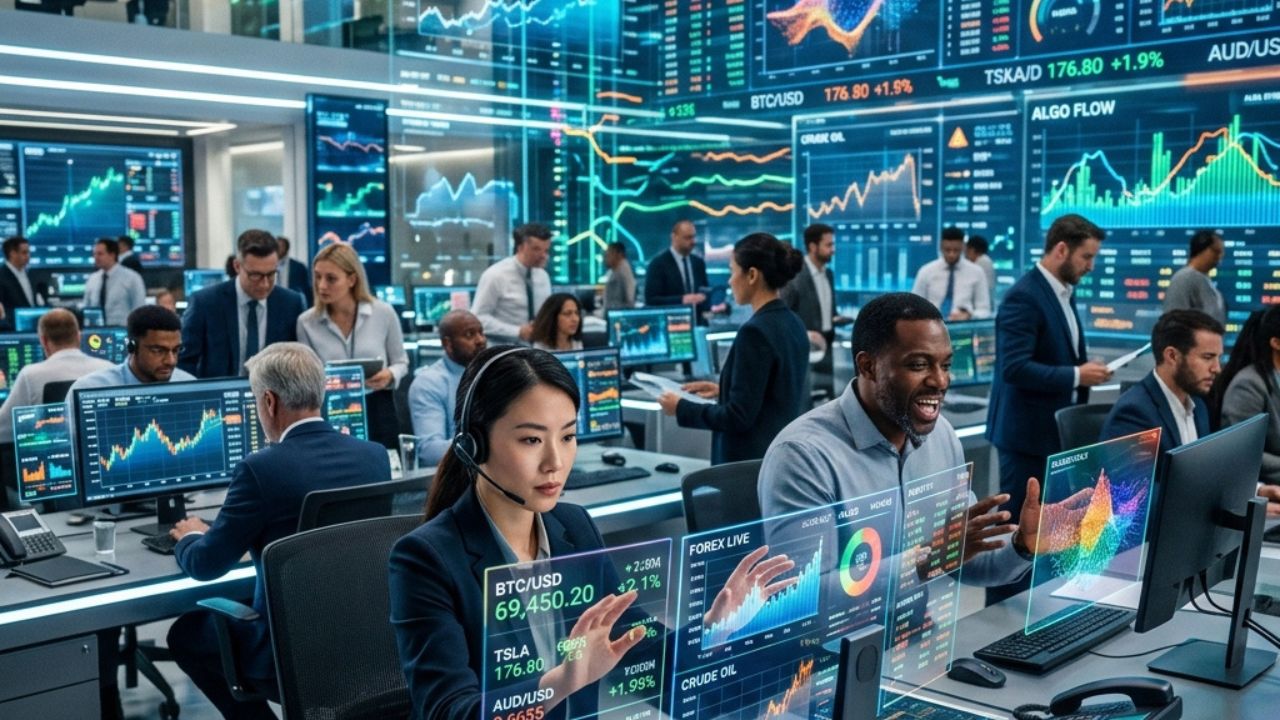
AI-powered investing uses machine learning, predictive analytics, and natural language processing to analyze market data, forecast price movements, and execute trades faster and more accurately than traditional methods. Both forex and stock market traders increasingly rely on these tools for pattern recognition, sentiment analysis, and risk management, giving them an edge in fast-moving, data-heavy markets.
Trading floors used to run on instinct, experience, and a good pair of lungs for shouting orders. That world has largely disappeared. In its place is a landscape shaped by algorithms that can process years of market data in seconds and spot patterns no human trader could catch in a lifetime.
AI-powered investing refers to the use of machine learning, natural language processing, and predictive analytics to analyze financial markets, forecast price movements, and execute trades. Unlike traditional technical analysis, which relies on historical charts and fixed rules, AI systems learn from data continuously, adjusting their models as new information arrives. This adaptability makes them particularly useful in markets like forex, where currency values shift on geopolitical news, interest rate decisions, and economic reports within minutes.
The shift from manual and rules-based trading to AI-driven strategies isn’t a niche trend. Hedge funds, investment banks, and increasingly, individual retail traders are integrating AI tools into their workflows. Whether you’re trading currency pairs or building a stock portfolio, understanding how these technologies work is no longer optional. It’s becoming a baseline requirement for staying competitive.
This post breaks down how trading technology evolved into what it is today, the specific AI tools reshaping forex and stock market strategies, and the concrete benefits traders can expect from adopting them.
How Did Trading Technology Evolve From Manual to Algorithmic Methods?
Trading has moved through several distinct phases. In the earliest days, trades happened on physical exchange floors through open outcry, human brokers matching buyers and sellers in real time. This gave way to electronic trading in the 1970s and 1980s, which digitized order execution but still relied heavily on human decision-making.
The next major shift came with algorithmic trading in the 1990s and 2000s. Traders began coding rules-based strategies that could execute orders automatically based on predefined conditions, like moving average crossovers or price thresholds. This reduced execution time and removed some emotional bias from trading decisions, but the strategies themselves were still static. They followed fixed logic and couldn’t adapt to changing market conditions without manual reprogramming.
Machine learning changed that equation. Rather than following fixed rules, machine learning models identify patterns within massive datasets and adjust their predictions as new data comes in. This means a trading model can recognize subtle correlations between economic indicators, market sentiment, and price action that a human analyst might miss entirely, and it can refine its approach over time without being explicitly reprogrammed.
Major financial institutions have already built AI deep into their operations. JPMorgan Chase developed its LOXM trading algorithm to execute large equity trades while minimizing market impact. Renaissance Technologies has long used quantitative and machine learning models to run its Medallion Fund, one of the most successful hedge funds in history. These aren’t experimental side projects. They represent core infrastructure for how these firms trade.
What AI Technologies Are Transforming Forex Trading?
The forex market presents unique challenges: it operates 24 hours a day, involves complex geopolitical variables, and reacts to news events almost instantaneously. AI tools are particularly well suited to handle this complexity.
Predictive Analytics and Pattern Recognition for Currency Movements
Predictive analytics models analyze historical price data, economic indicators, and macroeconomic trends to forecast future currency movements. These models can identify recurring patterns across multiple currency pairs simultaneously, something that would take a human analyst considerably longer to accomplish manually. Machine learning algorithms, particularly recurrent neural networks, are well-suited for this task because they can process sequential time-series data and detect trends that unfold over days or weeks.
Natural Language Processing for Sentiment Analysis and News Impact
Currency values often move on news: central bank statements, employment reports, or political developments. Natural language processing (NLP) allows AI systems to scan news articles, social media posts, and central bank communications in real time, assessing sentiment and predicting how markets might react. Choose NLP-based sentiment tools if your trading strategy depends on reacting quickly to breaking news, since manual monitoring simply can’t match the speed of automated text analysis across hundreds of sources at once.
High-Frequency Trading Algorithms and Their Advantages
High-frequency trading (HFT) uses AI-powered algorithms to execute a large number of trades within fractions of a second. These systems capitalize on tiny price discrepancies across markets or exchanges, generating profit through volume rather than large individual gains. HFT requires substantial infrastructure investment, so it’s generally more accessible to institutional traders than individuals, but the underlying principles have influenced retail trading tools as well.
Risk Management Tools Powered by AI
AI-driven risk management systems continuously monitor open positions, market volatility, and correlations between assets to flag potential losses before they escalate. These tools can automatically adjust stop-loss levels or recommend position size changes based on real-time volatility readings, helping traders manage exposure more precisely than static risk rules would allow.
How Is AI Being Applied in Stock Market Investing?
Stock market investing benefits from many of the same AI capabilities used in forex, but the applications extend further into portfolio construction and fraud prevention.
AI-Driven Portfolio Optimization and Asset Allocation
AI models can analyze thousands of stocks simultaneously, weighing factors like historical performance, volatility, correlation between assets, and an investor’s risk tolerance to recommend optimal portfolio allocations. Robo-advisors such as Betterment and Wealthfront use this approach to automatically rebalance portfolios, ensuring they stay aligned with an investor’s goals without requiring constant manual oversight.
Earnings Prediction Models and Fundamental Analysis Automation
Traditionally, fundamental analysis required analysts to manually review earnings reports, balance sheets, and cash flow statements. AI tools now automate much of this process, scanning financial filings and even predicting earnings surprises based on patterns in a company’s historical reporting behavior, hiring trends, or supply chain data. This allows investors to identify opportunities faster and with less manual research.
Technical Analysis Powered by Machine Learning
Machine learning enhances traditional technical analysis by identifying complex chart patterns across multiple timeframes and asset classes simultaneously. Instead of relying on a fixed set of indicators like RSI or MACD, machine learning models can weigh dozens of variables at once, adjusting their significance based on which factors have been most predictive recently.
Fraud Detection and Market Manipulation Prevention
Exchanges and regulatory bodies use AI to detect unusual trading patterns that might indicate insider trading, pump-and-dump schemes, or other manipulative practices. These systems analyze trading volume, price movements, and account behavior to flag suspicious activity for further investigation, helping maintain market integrity at a scale human oversight alone couldn’t achieve.
What Are the Benefits of AI-Powered Investing?
Increased Accuracy
AI models process far more data points than a human analyst could realistically manage, and they do so without fatigue or emotional bias. By continuously learning from new market data, these systems refine their predictions over time, often achieving higher accuracy than static, rules-based approaches. This doesn’t mean AI eliminates risk entirely. Markets remain unpredictable, and models are only as good as the data they’re trained on. But for traders seeking to reduce guesswork and ground decisions in data-driven analysis, AI offers a meaningful accuracy advantage over traditional methods.
Where Should Traders Go From Here?
AI-powered investing isn’t about replacing human judgment. It’s about giving traders and investors better tools to process information at a scale and speed that manual methods can’t match. Whether you’re analyzing currency movements influenced by breaking news or rebalancing a stock portfolio based on shifting risk tolerance, AI technologies are increasingly the difference between reacting to the market and anticipating it.
For traders just starting to explore these tools, the practical next step is identifying which specific challenge you’re trying to solve, whether it’s faster news reaction, more precise risk management, or better portfolio diversification, and researching platforms built specifically for that use case. AI in trading isn’t a single tool but a category of technologies, each suited to different strategies and risk appetites.
Frequently Asked Questions
Is AI-powered investing suitable for beginner traders?
Yes, though beginners should start with established robo-advisors or platforms that offer AI-driven portfolio management rather than building custom trading algorithms. These platforms handle the technical complexity while still offering the benefits of data-driven decision-making.
How much does it cost to use AI trading tools?
Costs vary widely. Robo-advisors like Betterment charge management fees typically under 0.5% annually, while institutional-grade AI trading infrastructure used by hedge funds can require significant capital investment. Retail-focused AI trading platforms and signal services often charge monthly subscription fees.
What are the risks of relying on AI for trading decisions?
AI models are trained on historical data, which means they can struggle to predict unprecedented market events or “black swan” scenarios. Over-reliance on any single model without human oversight can also amplify losses if the underlying algorithm misreads a market shift.
Can AI completely replace human traders?
Not entirely. While AI excels at processing data and identifying patterns, human judgment remains valuable for interpreting unusual circumstances, setting overarching strategy, and making decisions during unprecedented market conditions that fall outside a model’s training data.
What’s the difference between algorithmic trading and AI-powered trading?
Algorithmic trading follows fixed, predefined rules set by a programmer. AI-powered trading uses machine learning models that adapt and improve based on new data, making it more flexible in responding to changing market conditions.
Meta data
Meta title
AI-Powered Investing: The Future of Forex & Stock Trading
Meta description
Discover how AI is transforming forex and stock market investing through predictive analytics, sentiment analysis, and smarter risk management tools.# AI-Powered Investing: The Future of Forex & Stock Market Profits
Quick answer: AI-powered investing uses machine learning, predictive analytics, and natural language processing to analyze market data, forecast price movements, and execute trades faster and more accurately than traditional methods. Both forex and stock market traders increasingly rely on these tools for pattern recognition, sentiment analysis, and risk management, giving them an edge in fast-moving, data-heavy markets.
Trading floors used to run on instinct, experience, and a good pair of lungs for shouting orders. That world has largely disappeared. In its place is a landscape shaped by algorithms that can process years of market data in seconds and spot patterns no human trader could catch in a lifetime.
AI-powered investing refers to the use of machine learning, natural language processing, and predictive analytics to analyze financial markets, forecast price movements, and execute trades. Unlike traditional technical analysis, which relies on historical charts and fixed rules, AI systems learn from data continuously, adjusting their models as new information arrives. This adaptability makes them particularly useful in markets like forex, where currency values shift on geopolitical news, interest rate decisions, and economic reports within minutes.
The shift from manual and rules-based trading to AI-driven strategies isn’t a niche trend. Hedge funds, investment banks, and increasingly, individual retail traders are integrating AI tools into their workflows. Whether you’re trading currency pairs or building a stock portfolio, understanding how these technologies work is no longer optional. It’s becoming a baseline requirement for staying competitive.
This post breaks down how trading technology evolved into what it is today, the specific AI tools reshaping forex and stock market strategies, and the concrete benefits traders can expect from adopting them.
How Did Trading Technology Evolve From Manual to Algorithmic Methods?
Trading has moved through several distinct phases. In the earliest days, trades happened on physical exchange floors through open outcry, human brokers matching buyers and sellers in real time. This gave way to electronic trading in the 1970s and 1980s, which digitized order execution but still relied heavily on human decision-making.
The next major shift came with algorithmic trading in the 1990s and 2000s. Traders began coding rules-based strategies that could execute orders automatically based on predefined conditions, like moving average crossovers or price thresholds. This reduced execution time and removed some emotional bias from trading decisions, but the strategies themselves were still static. They followed fixed logic and couldn’t adapt to changing market conditions without manual reprogramming.
Machine learning changed that equation. Rather than following fixed rules, machine learning models identify patterns within massive datasets and adjust their predictions as new data comes in. This means a trading model can recognize subtle correlations between economic indicators, market sentiment, and price action that a human analyst might miss entirely, and it can refine its approach over time without being explicitly reprogrammed.
Major financial institutions have already built AI deep into their operations. JPMorgan Chase developed its LOXM trading algorithm to execute large equity trades while minimizing market impact. Renaissance Technologies has long used quantitative and machine learning models to run its Medallion Fund, one of the most successful hedge funds in history. These aren’t experimental side projects. They represent core infrastructure for how these firms trade.
What AI Technologies Are Transforming Forex Trading?
The forex market presents unique challenges: it operates 24 hours a day, involves complex geopolitical variables, and reacts to news events almost instantaneously. AI tools are particularly well suited to handle this complexity.
Predictive Analytics and Pattern Recognition for Currency Movements
Predictive analytics models analyze historical price data, economic indicators, and macroeconomic trends to forecast future currency movements. These models can identify recurring patterns across multiple currency pairs simultaneously, something that would take a human analyst considerably longer to accomplish manually. Machine learning algorithms, particularly recurrent neural networks, are well-suited for this task because they can process sequential time-series data and detect trends that unfold over days or weeks.
Natural Language Processing for Sentiment Analysis and News Impact
Currency values often move on news: central bank statements, employment reports, or political developments. Natural language processing (NLP) allows AI systems to scan news articles, social media posts, and central bank communications in real time, assessing sentiment and predicting how markets might react. Choose NLP-based sentiment tools if your trading strategy depends on reacting quickly to breaking news, since manual monitoring simply can’t match the speed of automated text analysis across hundreds of sources at once.
High-Frequency Trading Algorithms and Their Advantages
High-frequency trading (HFT) uses AI-powered algorithms to execute a large number of trades within fractions of a second. These systems capitalize on tiny price discrepancies across markets or exchanges, generating profit through volume rather than large individual gains. HFT requires substantial infrastructure investment, so it’s generally more accessible to institutional traders than individuals, but the underlying principles have influenced retail trading tools as well.
Risk Management Tools Powered by AI
AI-driven risk management systems continuously monitor open positions, market volatility, and correlations between assets to flag potential losses before they escalate. These tools can automatically adjust stop-loss levels or recommend position size changes based on real-time volatility readings, helping traders manage exposure more precisely than static risk rules would allow.
How Is AI Being Applied in Stock Market Investing?
Stock market investing benefits from many of the same AI capabilities used in forex, but the applications extend further into portfolio construction and fraud prevention.
AI-Driven Portfolio Optimization and Asset Allocation
AI models can analyze thousands of stocks simultaneously, weighing factors like historical performance, volatility, correlation between assets, and an investor’s risk tolerance to recommend optimal portfolio allocations. Robo-advisors such as Betterment and Wealthfront use this approach to automatically rebalance portfolios, ensuring they stay aligned with an investor’s goals without requiring constant manual oversight.
Earnings Prediction Models and Fundamental Analysis Automation
Traditionally, fundamental analysis required analysts to manually review earnings reports, balance sheets, and cash flow statements. AI tools now automate much of this process, scanning financial filings and even predicting earnings surprises based on patterns in a company’s historical reporting behavior, hiring trends, or supply chain data. This allows investors to identify opportunities faster and with less manual research.
Technical Analysis Powered by Machine Learning
Machine learning enhances traditional technical analysis by identifying complex chart patterns across multiple timeframes and asset classes simultaneously. Instead of relying on a fixed set of indicators like RSI or MACD, machine learning models can weigh dozens of variables at once, adjusting their significance based on which factors have been most predictive recently.
Fraud Detection and Market Manipulation Prevention
Exchanges and regulatory bodies use AI to detect unusual trading patterns that might indicate insider trading, pump-and-dump schemes, or other manipulative practices. These systems analyze trading volume, price movements, and account behavior to flag suspicious activity for further investigation, helping maintain market integrity at a scale human oversight alone couldn’t achieve.
What Are the Benefits of AI-Powered Investing?
Increased Accuracy
AI models process far more data points than a human analyst could realistically manage, and they do so without fatigue or emotional bias. By continuously learning from new market data, these systems refine their predictions over time, often achieving higher accuracy than static, rules-based approaches. This doesn’t mean AI eliminates risk entirely. Markets remain unpredictable, and models are only as good as the data they’re trained on. But for traders seeking to reduce guesswork and ground decisions in data-driven analysis, AI offers a meaningful accuracy advantage over traditional methods.
Where Should Traders Go From Here?
AI-powered investing isn’t about replacing human judgment. It’s about giving traders and investors better tools to process information at a scale and speed that manual methods can’t match. Whether you’re analyzing currency movements influenced by breaking news or rebalancing a stock portfolio based on shifting risk tolerance, AI technologies are increasingly the difference between reacting to the market and anticipating it.
For traders just starting to explore these tools, the practical next step is identifying which specific challenge you’re trying to solve, whether it’s faster news reaction, more precise risk management, or better portfolio diversification, and researching platforms built specifically for that use case. AI in trading isn’t a single tool but a category of technologies, each suited to different strategies and risk appetites.
Frequently Asked Questions
Is AI-powered investing suitable for beginner traders?
Yes, though beginners should start with established robo-advisors or platforms that offer AI-driven portfolio management rather than building custom trading algorithms. These platforms handle the technical complexity while still offering the benefits of data-driven decision-making.
How much does it cost to use AI trading tools?
Costs vary widely. Robo-advisors like Betterment charge management fees typically under 0.5% annually, while institutional-grade AI trading infrastructure used by hedge funds can require significant capital investment. Retail-focused AI trading platforms and signal services often charge monthly subscription fees.
What are the risks of relying on AI for trading decisions?
AI models are trained on historical data, which means they can struggle to predict unprecedented market events or “black swan” scenarios. Over-reliance on any single model without human oversight can also amplify losses if the underlying algorithm misreads a market shift.
Can AI completely replace human traders?
Not entirely. While AI excels at processing data and identifying patterns, human judgment remains valuable for interpreting unusual circumstances, setting overarching strategy, and making decisions during unprecedented market conditions that fall outside a model’s training data.
What’s the difference between algorithmic trading and AI-powered trading?
Algorithmic trading follows fixed, predefined rules set by a programmer. AI-powered trading uses machine learning models that adapt and improve based on new data, making it more flexible in responding to changing market conditions.